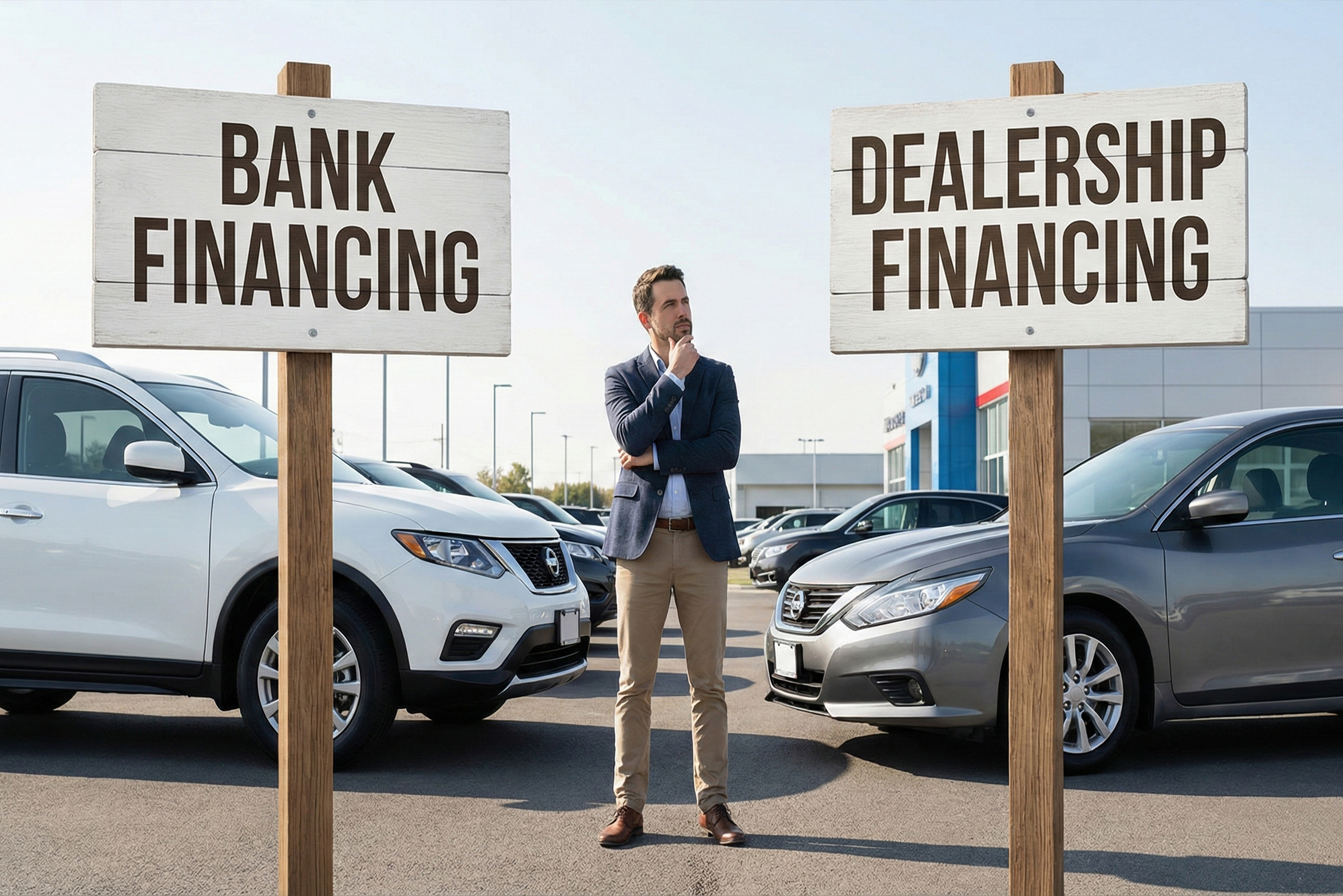
Dealer Financing vs. Bank Financing: Which Saves You More?
Are you considering purchasing a new set of wheels? Pump the brakes for a moment. While that new car fragrance and bright paint can be addictive, the most important decision you make might not be the color of the trim, but the source of your loan. Before you sign a single document, you must determine who is actually lending you the money.
The two main contenders in the auto lending arena are dealership financing and direct bank financing. Your choice between these two paths could literally save (or cost) you thousands of dollars over the life of the loan.
As a finance blogger, I’ve seen this decision confound even the smartest buyers. The process is often confusing by design, with dealerships blending the vehicle purchase and the loan into one murky transaction. This guide will break down the mechanics, the pros, the cons, and, most importantly, the ultimate strategy to ensure you drive away with the best possible deal.
I. Understanding the Basics: Direct vs. Indirect Lending
To make the best financial choice, you need to understand the fundamental difference between the two systems:
What is Direct Financing?
Direct financing occurs when you borrow money directly from an institution whose primary business is lending. This includes banks, credit unions, or online lenders.
- Your Role: You apply to the lender, get approved, and the lender gives you the money (or a commitment letter) before you ever walk onto the car lot.
- How it Works at the Dealership: With direct financing, you essentially become a “cash buyer.” You hand the dealership a check (or the funds transferred from your lender) for the full price of the car. The loan transaction is entirely separate from the purchase transaction.
What is Indirect (Dealership) Financing?
Indirect financing occurs when the dealership acts as a middleman between you and the actual lender.
- The Dealer’s Role: You fill out one application at the dealership, and they send it out to a network of different financial institutions local banks, national credit unions, and “captive” lenders (like Ford Credit or Toyota Financial).
- How it Works at the Dealership: The dealer receives several offers from various lenders (the “Buy Rate”). They then present you with an offer that includes a markup, known as the “Customer Rate.” You sign the loan agreement at the dealer, who then sells the contract to the chosen lender.
II. Option 1: The Bank or Credit Union Route (The Smart Shopper’s Ace)
Securing your financing directly puts power and leverage back in your hands.
The Pros of Direct Financing
- Lower Interest Rates are the Biggest Win: Banks and especially credit unions often offer the most competitive Annual Percentage Rates (APR). Because their sole business is lending, they do not need to add the markup (the dealer reserve) that dealerships profit from. For well-qualified borrowers, rates are often significantly more competitive than what a dealer might quote initially.
- Pre-Approval Power and Leverage: Getting pre-approved turns you into a “cash buyer” at the dealership. You walk onto the lot knowing precisely how much you can spend and, crucially, the best interest rate you’re willing to accept. This allows you to negotiate the car’s price without the dealer trying to distract you with loan terms.
- Unmatched Transparency: Direct lenders are usually very upfront about all fees and terms, including origination fees, pre-payment penalties (which are rare in auto loans but important to check), and the amortization schedule. What you see is generally what you get, making the process cleaner.
- Focus on the Car Price: Since the financing is locked in, you can focus 100% of your negotiation energy on getting the absolute lowest price for the vehicle itself.
The Cons of Direct Financing
- More Legwork is Required: You have to shop around for rates, apply to multiple institutions, and wait for approval all before setting foot on the lot. This takes a little extra time and effort.
- Stricter Requirements: Banks typically have stricter credit score and income requirements than dealership lenders. If your credit is borderline or needs work, a direct lender might turn you down where a dealer’s network might find a subprime lender.
III. Option 2: Dealership Financing (The Convenience Trap)
While convenient, financing through the dealership carries inherent conflicts of interest that can cost you money.
The Pros of Dealership Financing
- Unbeatable Convenience: It’s one-stop shopping. You pick the car, fill out one application, and drive home sometimes all in the same day. For buyers prioritizing speed, this is the main draw.
- Promotional Rates (The Big Lure): This is the one area where the dealer may occasionally offer a superior deal. In order to move inventory, manufacturers frequently offer “special financing” on new cars at extremely low rates (such as 0% or 1.9% APR). If you qualify for these subsidized rates, they are almost always the best option.
- Flexible for Subprime Credit: Dealers often have access to lenders willing to finance buyers with less-than-perfect credit. They know which lenders specialize in higher-risk profiles, which can be a lifesaver if traditional banks turn you down.
The Cons of Dealership Financing
- The Rate Markup (The Dealer Reserve): The dealer is fundamentally in the business of maximizing profit. When they secure a loan for you, they receive a “Buy Rate” from the lender. They then have the right to mark up that rate often by up to 2.5 percentage points and pocket the difference as a commission. That small increase in APR is your money, not the lender’s, and it’s a significant profit center for the dealership.
- The Distracted Negotiation Tactic: When you discuss the loan and the car price simultaneously, it’s easy for the dealer to confuse you. This is known as “payment packing.” They might give you a slightly lower price on the car but compensate by increasing your interest rate, selling you unnecessary add-ons (like extended warranties), or lengthening the loan term. You focus only on the monthly payment, losing track of the total cost.
- Limited Transparency: While the dealer must disclose the final APR, the initial process of shopping your application around is opaque. You don’t see the “Buy Rate” and have no way to verify if the dealer is giving you the best rate they secured.
IV. The Hidden Cost: How the APR Markup Works
Understanding the “dealer reserve” is crucial for protecting your wallet.
When a lender (Bank A) approves your application, they tell the dealer: “We will fund this loan at 5.0% APR” (the Buy Rate).
The dealer then tells you: “We got you approved for 7.0% APR” (the Customer Rate).
The difference the 2.0% markup is the dealer’s profit. While 2.0% might sound small, consider a 30,000 loan financed over 60 months.
| Rate (APR) | Monthly Payment | Total Interest Paid |
| 5.0% (Buy Rate) | $566 | $3,959 |
| 7.0% (Customer Rate) | $594 | $5,638 |
In this simple example, the 2% markup costs you an additional $1,679 in interest that goes straight into the dealer’s pocket. This is why always securing your own financing first is the superior strategy.
V. Beyond the Rate: Additional Factors to Consider
High-quality financing advice goes beyond just the APR. Consider these other critical elements:
A. The Loan Term (e.g., 60 vs. 72 Months)
Lenders and dealers often push longer loan terms (72 or even 84 months) because they result in a lower monthly payment, making the vehicle seem more affordable.
- The Danger: The longer the term, the more interest you pay overall, often by thousands. Furthermore, the longer the loan, the greater the risk of becoming “upside down” (owing more on the car than it is worth, also known as negative equity). A shorter term (48 or 60 months) is almost always the financially healthier choice.
B. The Impact of Credit Score
Your credit score is the single greatest determinant of your APR.
- FICO Score 720 and Above: You are considered a well-qualified borrower and should easily be able to secure the lowest rates from direct lenders.
- FICO Score Below 660: You will likely need to explore subprime lending options. While banks may still be competitive, the dealer’s network might be your only avenue for approval, albeit at a higher cost.
C. Pre-Payment Penalties
Always check your loan contract for a pre-payment penalty. A penalty means you will be charged a fee if you pay off the loan early. Most auto loans today are simple-interest loans without this penalty, but it is a critical detail to confirm before signing.
VI. The Ultimate Strategy: The Dual Approach
The fundamental rule of car financing is this: Always get pre-approved by your bank or credit union FIRST.
Why? Because your pre-approval becomes your financial safety net and your most powerful negotiation tool.
Step-by-Step for the Smart Buyer:
- Get Your Quote: Shop at least two direct lenders (your primary bank and a local credit union) to secure your best possible pre-approved interest rate and loan amount.
- Negotiate the Price Only: Go to the dealership with your pre-approval letter in hand. Do not mention the letter yet. Negotiate the lowest possible price of the automobile first, treating it as a cash purchase.
- Use the Pre-Approval as Leverage: Once the car price is locked in, then tell the dealer you already have financing secured at, for example, 5.0% APR.
- Make Them Compete: The dealership will run your credit application through their own network. You can tell the finance manager: “If you can beat 5.0% APR, I’ll take your loan. If you can’t, I will use my credit union’s loan.”
By making the dealership compete not just on the price of the automobile but also on the cost of borrowing, this tactic guarantees that you will receive the lowest possible total price. Whether you end up using your bank’s loan or the dealer’s (if they can secure a better rate), you are in control.
You’re very welcome, and happy car shopping!
Latest Post
- Revolution Casino entfesselt Glück mit dem No Deposit Bonus Geheimcode
- Εξερευνώντας τις ανατροπές του Revolution Casino με κριτικές που καθηλώνουν
- Odkrijte vznemirjenje mr pacho online kazinoja in osvojite srečo
- Odkryj tajemnice kodu promocyjnego Admiralbet i wygraj więcej
- Admiralbet Login entfesselt Ihre Wettleidenschaft sofort